
Custom Shower Planning
Marble Slab Shower vs. Tile Shower: Which Is Better for East Texas Homes?
Marble slab showers create a premium look with large natural-stone surfaces and fewer joints, while tile showers provide more flexibility, easier localized repairs, and a much wider range of budgets. For most homeowners, porcelain tile offers the stronger overall balance. Marble slab makes the most sense when the seamless-looking appearance is worth the higher cost and natural-stone maintenance.
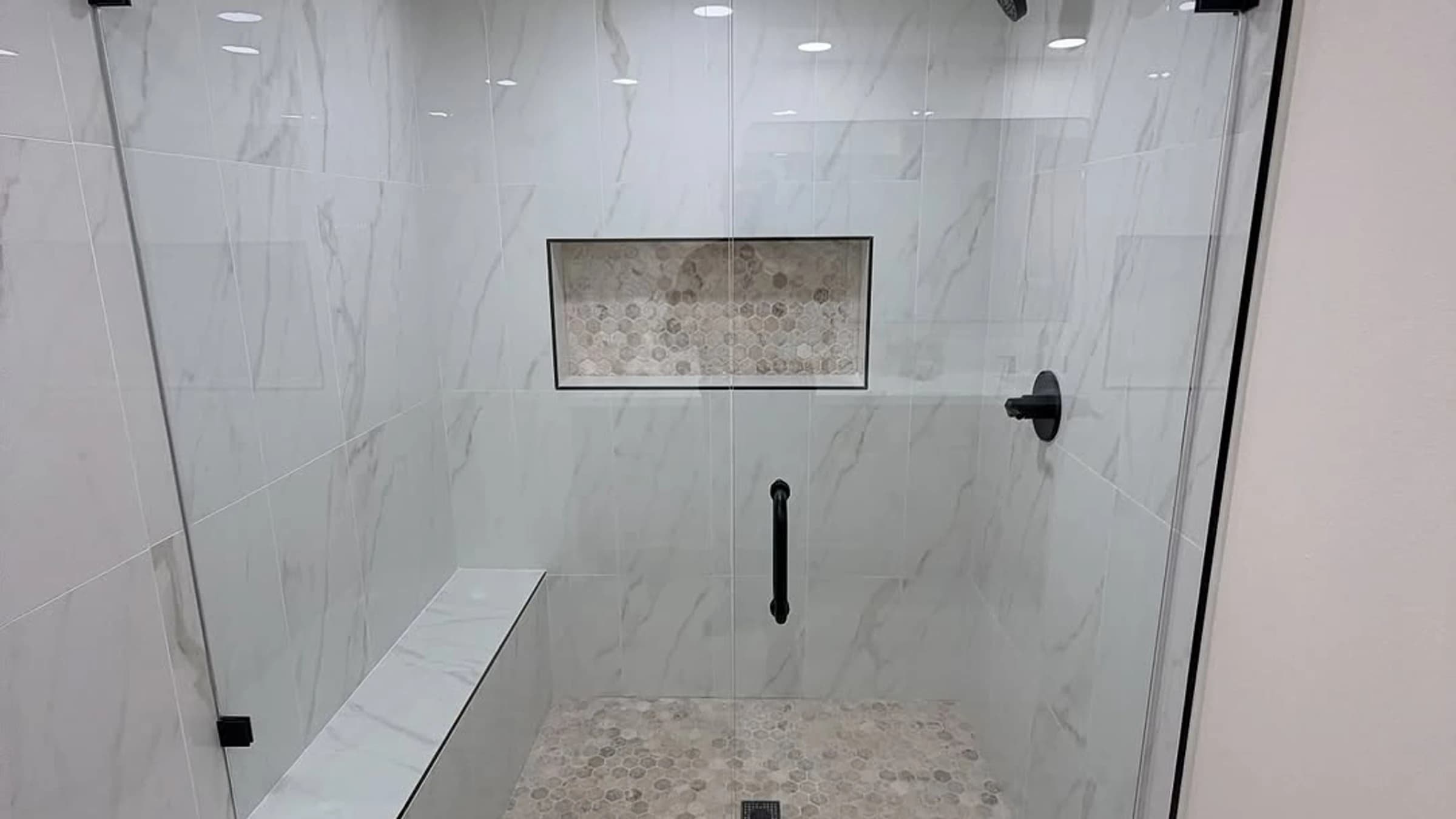
Representative Pioneer tile-shower image; it does not show natural marble slab.
Quick answer
For most homeowners, a well-built porcelain tile shower provides the better overall balance of cost, customization, repairability, and maintenance. A natural marble slab shower is the premium choice for homeowners who prioritize dramatic stone appearance and fewer grout joints enough to accept higher material cost, specialized fabrication, and natural-stone care.
Tile has more overall advantages for most homeowners, especially when the tile is porcelain. Marble slab wins on dramatic natural-stone appearance and fewer grout joints, but it generally costs more, requires specialized fabrication, is harder to repair, and natural marble can stain or etch. High-end specialty tile can still cost more than some slab projects, and installation quality matters more than material format alone.
What is a natural marble slab shower?
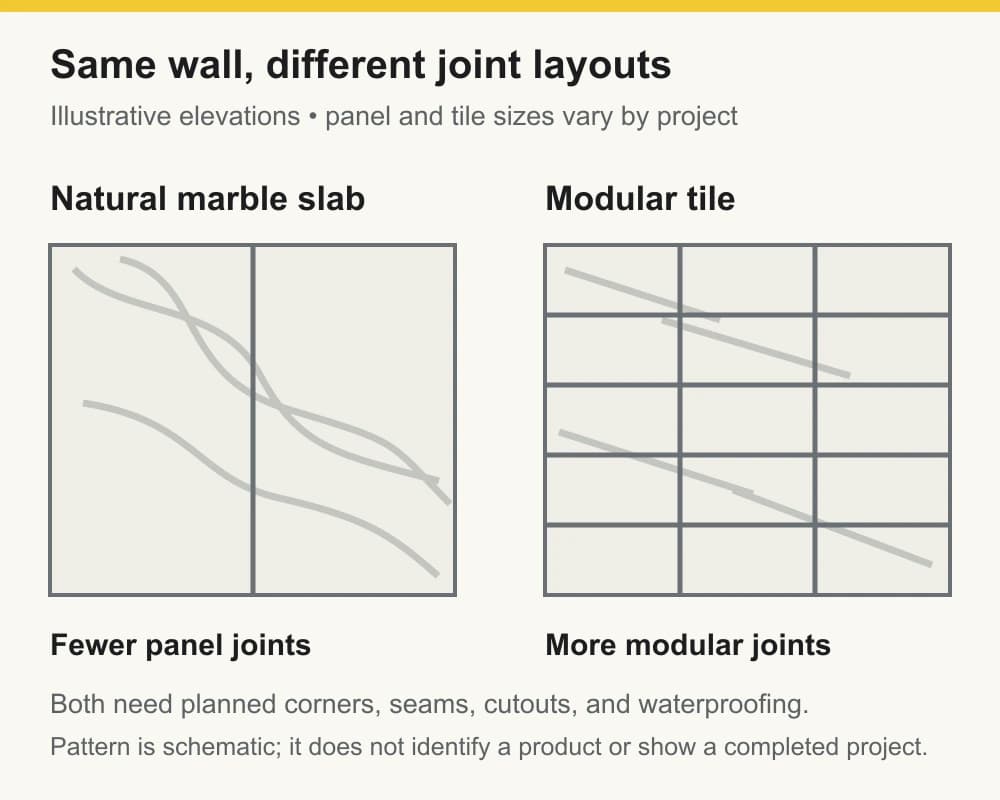
Natural marble slab shower walls use large pieces cut and fabricated from quarried stone, creating broad, naturally varied surfaces with fewer joints than modular tile. A fabricator templates the walls, plans panel placement, and cuts for fixtures, niches, benches, windows, and other details before the heavy panels are transported and installed.
Slab does not mean grout-free, joint-free, or seam-free. Corners, panel joints, benches, niches, and penetrations may still need seams or flexible sealant. Vein coordination or book-matching may be possible with suitable stone and planning, but exact alignment is not guaranteed.
What is a traditional tile shower?
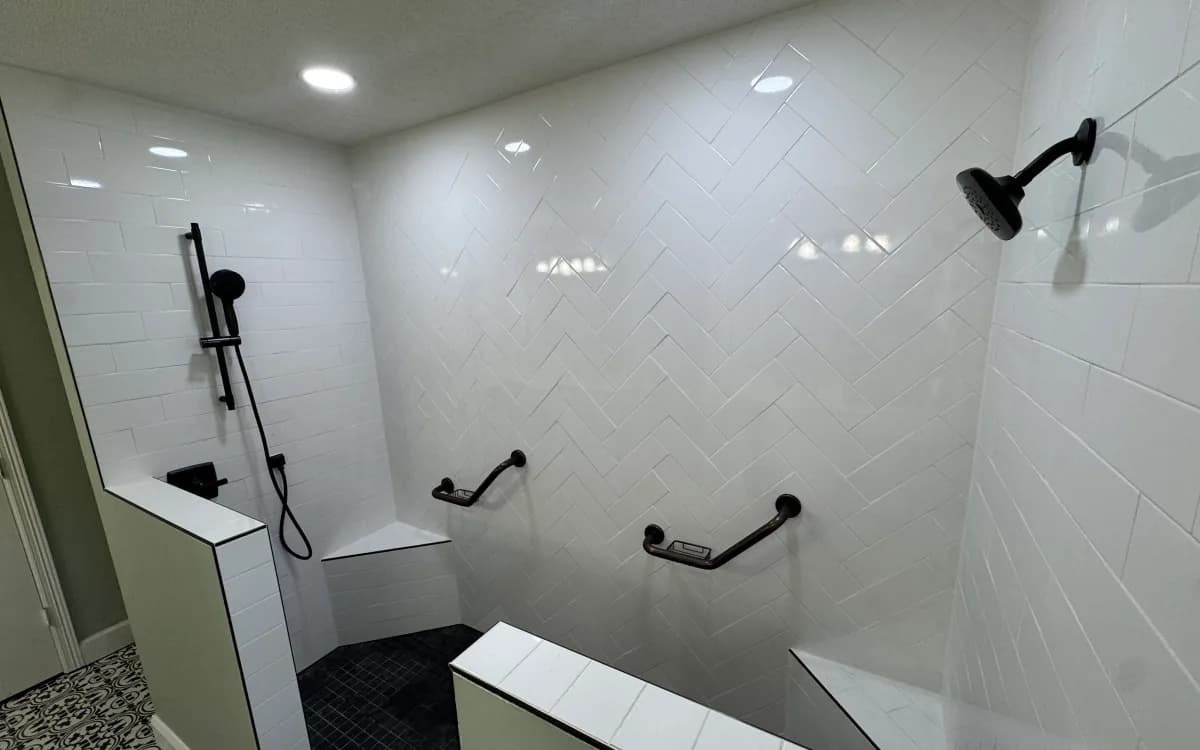
A tile shower uses modular pieces installed individually over a properly planned shower assembly. Options include porcelain, ceramic, natural-stone tile, glass accents, mosaics, and large-format tile. The variety supports detailed patterns and layouts. The guide to planning a custom tile shower explains how those finish decisions connect to the full scope.
Maintenance depends on the actual tile and grout. Natural marble tile does not have the same care profile as porcelain. When durability and lower surface maintenance are the priorities, porcelain tile is generally the strongest tile comparison.
Quick comparison
| Factor | Natural Marble Slab | Tile Shower |
|---|---|---|
| Appearance | Large natural-stone surfaces with unique veining and variation | Broad range of colors, sizes, patterns, finishes, and materials |
| Number of joints | Fewer joints, but not joint-free or seam-free | More grout joints, depending on tile size and layout |
| Material cost | Often higher with stone, fabrication, transport, and handling | Wide range from practical porcelain to premium specialty tile |
| Installation complexity | Precise templating, fabrication, heavy handling, and panel planning | Careful layout and setting; complexity rises with size and pattern |
| Design flexibility | Strong natural-stone statement, but fabrication-dependent | Greater flexibility for patterns, accents, borders, and material changes |
| Niches and benches | Possible, with early cutout, edge, seam, and panel planning | Usually easier to adapt around detailed or irregular features |
| Maintenance | Stone-safe care; staining, etching, and sealing guidance may apply | Porcelain is generally easier to maintain; grout still needs care |
| Repairability | Matching unique stone or replacing a damaged panel can be difficult | Individual tiles may sometimes be replaced when matching material remains |
| Shower-floor options | Often paired with mosaic tile or another sloped floor system | Small-format tile can follow changing floor planes more easily |
| Best fit | Premium natural-stone appearance and fewer joints | Overall value, flexibility, product access, and localized repairability |
Marble slab shower pros
- Fewer grout joints to clean than a modular tile wall
- Large, uninterrupted surfaces with unique veining and premium visual impact
- Potential for coordinated or book-matched stone when suitable material is available and properly fabricated
Marble slab shower cons
- Material, templating, fabrication, transport, and installation often cost more
- Heavy panels need specialized handling, and fewer fabricators or installers may be qualified
- Niches, benches, windows, corners, and fixture cutouts add fabrication complexity and risk
- A damaged panel has greater consequences, and matching unique veining later may be difficult
- Natural marble can stain and can etch when exposed to acidic cleaners or products
- Sealing guidance may apply, but a sealer does not prevent acid etching or make stone stain-proof
- Visible seams can still occur at corners, panel joints, features, and penetrations
Tile shower pros
- A broad range of materials, prices, colors, sizes, and layouts
- Flexible accents and layouts around corners, pony walls, windows, niches, and benches
- Individual tile replacement may be possible when matching material remains
- Porcelain tile is generally resistant to staining and everyday bathroom use
- Small-format tile follows the changing planes of a sloped shower floor well
- Installers and materials are generally easier to source
Tile shower cons
- More grout joints require cleaning and maintenance
- Layout errors, lippage, uneven joints, and poor cuts remain visible
- Complex patterns and accent areas can increase labor
- Discontinued tile can be difficult to match later
- Natural-stone tile may require care similar to natural marble slab
- Large-format tile still requires flat walls and careful installation
- Tile quality and grout or sealant choices can change the maintenance burden
Cost factors: compare the complete written scope
Natural marble slab: stone selection, slab size and availability, templating, fabrication, edge finishing, fixture cutouts, niche and bench work, transportation, specialized handling, installation, and waste or breakage risk all affect cost.
Tile: material, tile size, pattern complexity, wall preparation, waterproofing, grout, niches and benches, edge trim, labor, shower floor, drain, and glass coordination shape the total. A high-end tile shower can cost more than a simple slab installation, so homeowners should compare the complete written scope instead of comparing material names alone. Review the separate guide to shower remodel cost factors before comparing estimates.
Maintenance and cleaning
Fewer joints can reduce grout-line cleaning on marble slab walls. Natural marble should be cleaned with stone-safe, pH-neutral products; acidic products such as vinegar or lemon can etch it. Sealing may reduce staining, but it does not prevent etching or make marble stain-proof. Follow the supplier, fabricator, and care-product guidance instead of a universal schedule.
Porcelain is generally easier to maintain, but grout still needs cleaning. Grout, sealant, surface finish, and manufacturer instructions matter. Changes of plane normally use suitable flexible sealant rather than rigid grout.
Neither marble slab nor tile is the shower waterproofing system
Both finishes need coordinated backing, waterproofing, a shower pan, drain, slope, corners, niches, benches, fixture penetrations, movement, and changes of plane. Slab walls do not remove those requirements, and tile and grout are not waterproof.
Ask the estimate to identify the system behind the finish. Pioneer's tile shower waterproofing guide explains the hidden assembly in more detail.
Shower floors are a separate product decision
A shower with slab walls does not automatically use slab material on the floor. It may use small-format mosaic tile, a fabricated shower base, or another floor system designed to slope to the drain. Small-format tile can follow changing shower-floor planes more easily, but extra joints do not guarantee traction. Confirm wet-area suitability and slip-resistance information in the selected product's technical documentation.
Niches, benches, and custom layouts
Tile adapts readily around niches, benches, pony walls, windows, corners, and accent patterns, with several edge-treatment choices. Marble slab can also be fabricated around custom features, but measurements, cutouts, edges, seams, and panel joints must be planned early. More complicated geometry can increase fabrication cost and risk. For an especially complex floor transition, review the curbless shower planning guide.
Repairability
An individual tile can sometimes be replaced if matching material remains, so homeowners should keep spare tile. Discontinued products can still be difficult to match. Unique natural slab damage may require a stone-restoration specialist or major panel work. Repair options depend on the damage and installation; an invisible repair should not be promised.
Which option is better?
Choose based on what matters in the finished room, not the material name.
Choose porcelain tile when you prioritize
- Better overall value across a wider range of budgets
- More design choices and adaptable niches or benches
- Easier localized repair when spare matching tile is available
- Lower natural-stone maintenance demands
- Broader access to installers and products
Choose natural marble slab when you prioritize
- A premium natural-stone appearance with large uninterrupted surfaces
- Fewer grout joints and dramatic, one-of-a-kind veining
- Acceptance of higher cost, specialized fabrication, and harder matching
- Willingness to use stone-safe cleaners and follow stone-specific care guidance
Questions homeowners should ask
- Is the proposed slab natural marble, porcelain, cultured marble, or another material?
- Who handles templating and fabrication?
- How many visible seams will there be?
- How will corners and changes of plane be finished?
- What cleaning products are approved?
- Does the material require sealing, and what does sealing protect against?
- How are niches and benches fabricated?
- What will be used on the shower floor?
- What waterproofing system is included?
- What happens if a panel or tile is damaged later?
- Are extra materials included for future repairs?
- Is shower glass included, and what is excluded from the estimate?
Final verdict
For most East Texas homeowners, porcelain tile has more practical advantages than natural marble slab. It offers more flexibility, a wider budget range, easier repairs, and lower material-maintenance demands. Marble slab is the stronger luxury choice when fewer joints and natural-stone appearance matter more than cost and upkeep.
The best overall value for most homeowners is porcelain tile. The best premium appearance with fewer joints is natural marble slab. The right choice still depends on budget, maintenance tolerance, design goals, installation complexity, and repair expectations.
Your next step
Compare the complete shower scope before choosing a finish
Pioneer can help homeowners compare shower layouts, finish options, waterproofing details, and project scope without assuming one material is right for every home.